

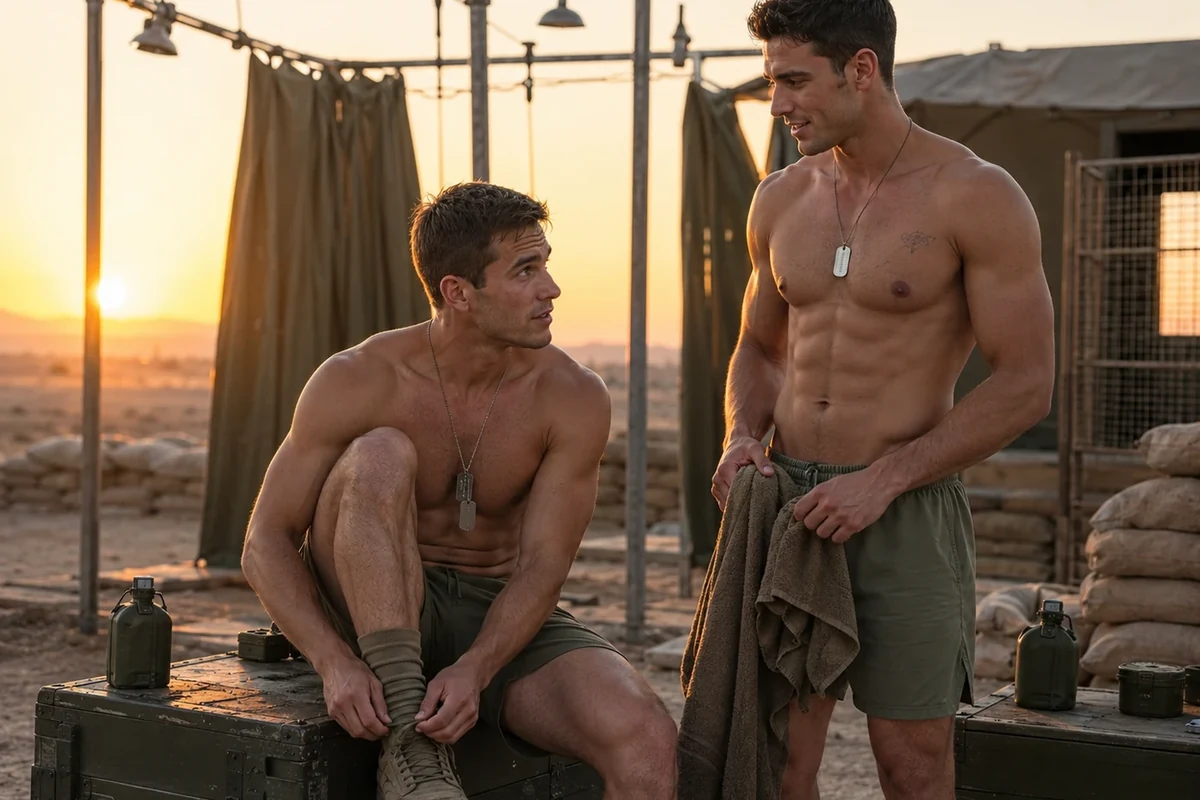
Locker-room imagery communicates training, camaraderie and post-workout energy. Responsible adult branding can use that atmosphere without implying minors, real affiliations or nonconsensual access.
Key takeaways
- Public tags are useful discovery signals, not verified measurements.
- Provider fields, imagery and live context can differ.
- Privacy, consent and current room rules remain central.
- External networks operate accounts, payments and moderation.
Clearly adult casting matters
Editorial scenes should depict unmistakably adult men and avoid school names, youth leagues or age-ambiguous styling.
The practical standard is to use current public context without adding certainty that the source data cannot support.
Fictional branding avoids affiliation
Invented apparel and neutral equipment reduce the risk of implying endorsement by a real team or organization.
The practical standard is to use current public context without adding certainty that the source data cannot support.
Camaraderie is not a relationship claim
People pictured together should read as adult friends or training partners, not relatives or a specific real team.
The practical standard is to use current public context without adding certainty that the source data cannot support.
Avoid surveillance framing
The scene should feel openly photographed, not like hidden-camera access to a private changing space.
The practical standard is to use current public context without adding certainty that the source data cannot support.
Live rooms remain independent
Editorial imagery sets the site mood. External performer rooms have their own context, rules and provider labels.
The practical standard is to use current public context without adding certainty that the source data cannot support.
How to apply this while browsing
Begin with the broad military jocks feed, then narrow by a word that describes the current intent: muscle, lean, abs, jock, gym, runner, swimmer or a specific sport. Read the complete room subject and visible provider labels before deciding that a match is relevant. A single tag can be inherited from an older profile or used more broadly than a viewer expects.
When the room opens, treat the current broadcast as the source of context. Lighting, wardrobe, camera position and the performer’s plans can change from one session to another. Use official platform controls for follows, tips, private sessions, reports and account settings. Do not use a directory category as a reason to push for measurements, proof, real-team details or physical activity that is not offered.
Finally, keep uncertainty visible. The most responsible conclusion is often that a room appears compatible with an military jocks search, not that the directory has verified a body, identity, profession, competition record or location. That distinction keeps search useful without turning incomplete public data into a factual claim.
Common mistakes to avoid
Put the guidance into practice
Start with one deliberate change rather than trying to remember every rule at once. For viewers, that may mean reading the current room menu before spending, enabling stronger account security, or setting a written session budget. For performers, it may mean reviewing the visible background, separating personal and stage accounts, or documenting one repeatable moderation response.
Recheck the choice whenever the provider, room status, price, device, audience, or privacy context changes. Live platforms move quickly, but the underlying standard stays stable: use official tools, minimize unnecessary data, preserve consent, keep spending and production decisions controllable, and stop when the facts are unclear.
A four-step decision framework
Use this sequence when a room, payment, request, account setting, or production choice is moving quickly. It converts broad principles into a repeatable check.
| 1. Identify the feature | Decide whether the action is ordinary chat, a public tip, a listed menu item, a room goal, a private session, a follow, or an account change. |
|---|---|
| 2. Read the visible terms | Use the current room title, menu, price, timer, provider notice, and posted rule rather than memory or assumptions from another room. |
| 3. Protect choice | Keep the action within budget, minimize personal data, preserve consent, and choose an option that can be stopped without argument. |
| 4. Respect the answer | A decline, changed menu, offline room, technical limit, or safety boundary ends the request. Use support only for a genuine technical or billing issue. |
The framework is deliberately conservative. It keeps normal participation simple while creating a clear stopping point when consent, identity, price, privacy, or safety is uncertain.
Practical checklist
Run through these items before a session or whenever a room, account, payment, or workflow changes.
Frequently asked questions
Does MilitaryJocks.cam represent a real team?
No.
Are hero models live performers?
No. Editorial images are illustrative.
Why avoid school logos?
They can imply affiliation and create age ambiguity.
Can locker-room imagery still be sexy?
Yes, while keeping every subject clearly adult and the setting openly editorial.
This guide is educational and general. Accounts, broadcasts, age checks, moderation, payments and performer interactions occur on external platforms under their current terms. MilitaryJocks.cam does not process payments or operate those networks.