

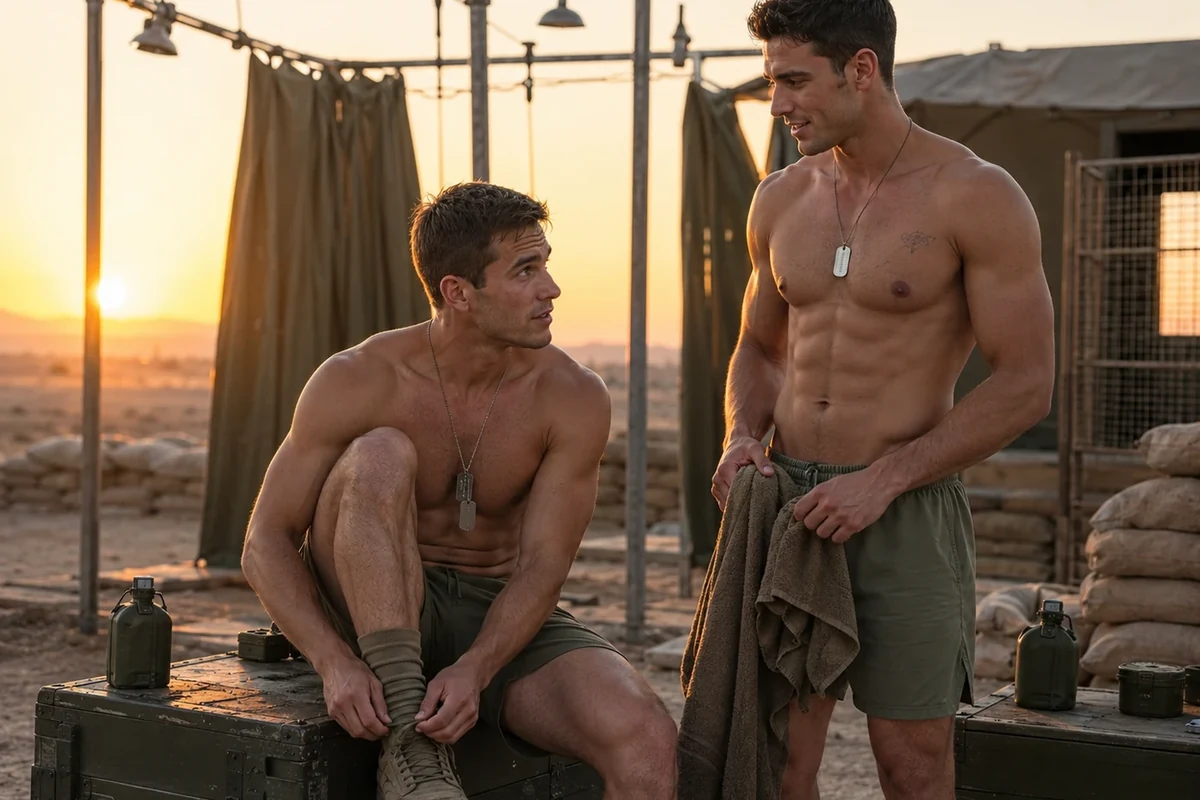
Military life can involve far less bodily privacy than civilian life, especially during entrance processing, basic training, field exercises and deployments. The main reason is not eroticism. It is institutional design: large groups, shared facilities, compressed schedules, medical screening, sanitation needs and direct-observation rules.
This article summarizes a user-supplied analysis. Its broad description of communal military environments is plausible, but its numerical encounter totals and some facility-specific claims were not independently verified for this edition. Treat the figures as illustrative modeling, not official Department of Defense statistics.
Key takeaways
- Privacy is usually lowest during reception and initial entry training.
- Open-bay housing, shared changing areas and high-throughput showers drive most routine exposure.
- Modern permanent-party barracks generally provide much more privacy.
- Field exercises, ships and forward operating locations can restore communal conditions.
- Direct-observation urinalysis creates a separate, regulation-driven loss of privacy.
Processing and reception establish the pattern
Before formal training begins, applicants move through medical screening, drug testing, clothing issue and reception barracks. Some examinations are private, but waiting areas, group mobility checks, shared restrooms and open-bay reception quarters can still make privacy limited.
The supplied analysis describes reception as a short but intense transition from civilian expectations to institutional routines. Recruits may change clothing several times a day, sleep in rooms holding dozens of people and use communal latrines while learning to move as a group.
Why basic training is the peak communal phase
Initial entry training combines large cohorts with strict time limits. A platoon, flight or division may need to wash, dress and move on within minutes. Older facilities often use open gang showers or rows of stalls without front doors. Newer facilities may add partitions, but shared changing space and rapid turnover still reduce privacy.
The essential point is architectural and operational. Training sites are designed to process groups efficiently, maintain accountability and keep schedules moving. A recruit can therefore be around many unclothed peers during a single hygiene period even when nobody is paying special attention to anyone else.
Branch, cohort and construction era matter
The source argues that Marine Corps recruit training generally creates the highest baseline exposure because of large platoons, long training cycles and traditional squad-bay layouts. Army and Navy experiences vary widely by installation and building age. Air Force and Coast Guard training may involve smaller groups or more partitioned facilities, though communal living remains part of the experience.
These comparisons should not be treated as universal rankings. Buildings are renovated, policies change and individual assignments differ. Two people in the same service can have very different experiences depending on the year, installation, unit and training pipeline.
Privacy usually increases after initial training
Once service members reach technical training or permanent assignments, housing generally becomes less communal. Modern unaccompanied housing often uses private or semi-private bedrooms connected to a shared bathroom for only a few residents. Routine exposure may then be limited to gyms, locker rooms, temporary unit changing areas or occasional field events.
This is the biggest shift in the source material: the highly communal boot-camp environment is not necessarily representative of an entire enlistment. Daily life in a modern garrison can look much closer to shared civilian housing.
Field operations, deployments and ships can reduce privacy again
Temporary environments prioritize mobility and sanitation. Personnel may live in tents, huts or crowded berthing compartments and use trailer-mounted showers, shared changing corridors, basic urinals or field latrines. Naval crews also operate in exceptionally tight spaces, where changing and hygiene occur near busy passageways.
Conditions vary from austere field sites to mature bases with enclosed facilities. The consistent factor is density: the more people living and working in limited space, the harder it is to preserve civilian-style privacy.
Direct-observation drug testing is a separate institutional factor
Military drug-testing programs may require a same-sex observer to watch a urine sample being produced so that substitution or tampering is less likely. For most service members, this is an occasional event. For personnel assigned as observers, it can involve monitoring many donors during a unit-wide collection.
This is different from incidental exposure in showers or barracks. It is an official integrity-control procedure with a defined operational purpose, and it illustrates how military rules can override ordinary privacy expectations.
How to read the numerical estimates
The supplied paper models cumulative “visual encounters” across a first enlistment and proposes ranges from hundreds in low-exposure modern garrison careers to many thousands in combat-arms, field-heavy or shipboard careers. It also suggests that initial training accounts for a large share of the baseline total.
Those numbers should be handled cautiously. The analysis appears to multiply assumed daily encounters by training days, deployments and observer duties. That can illustrate how exposure accumulates, but it does not establish how many unique people were seen, how long an encounter lasted, whether anyone actually noticed, or whether the assumptions represent the average service member.
| Most defensible conclusion | Military privacy varies sharply by phase, facility and mission. |
|---|---|
| Useful but uncertain conclusion | Initial training and field environments probably account for most communal exposure. |
| Not established by the source | A precise national average or a verified branch-by-branch lifetime count. |
What the pattern actually means
Communal nudity in military settings is usually mundane. It emerges from architecture, scheduling and institutional control rather than intimacy. Recruits quickly learn that bodies are present but not necessarily socially important.
That distinction matters for MilitaryJocks.cam. Our editorial imagery borrows the visual language of barracks, field showers and post-training camaraderie, but it is fictional adult entertainment. It should never be presented as hidden access to real service members, proof of anyone's military status or a documentary record of private military spaces.
Frequently asked questions
Are communal showers still universal in the military?
No. Facility design varies by service, installation, construction era and training environment. Modern permanent-party housing usually offers much more privacy than initial training or field settings.
Why is privacy lowest during initial training?
Large cohorts, open-bay housing and tightly scheduled hygiene blocks prioritize speed, supervision and throughput over personal space.
Does field service reduce privacy again?
Often. Tents, temporary shower units, shared changing areas and basic field sanitation can recreate high-density communal conditions.
Are the encounter estimates exact?
No. They are scenario-based estimates in the supplied analysis, not a verified Department of Defense statistic or representative survey result.
MilitaryJocks.cam uses fictional, clearly adult, military-inspired imagery. We do not claim that editorial models or live performers are active-duty service members, and we do not present communal military environments as inherently sexual.